Sewage Pumps
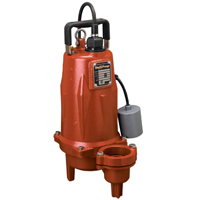
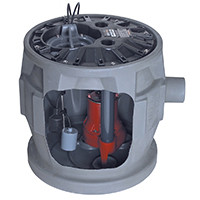
Sewage pumps are intended to be used to discharge liquid and solid waste from sewage tanks and receptacles to drain lines, or to a main sewer. These pumps are typically submersible, and are installed at the bottom of sewage basins or septic tanks. Submersible sewage pumps will usually have their intake at or near the bottom of the pump so as to allow the pump to empty as much of the tank as possible.
In contrast to sump pumps and effluent pumps, sewage pumps are able to handle large solids of up to 2 inches in diameter, in addition to wastewater. These pumps can be either manually or automatically operated. The automatic sewage pump models typically feature a float switch, which activates the pump when the water reaches a pre-set level.
Little Giant Sewage Pumps
Franklin Electric, Little Giant’s parent company, has been a big name on the global market for years. Little Giant pumps are known for their quality and their reliability, as each pump is tested prior to distribution. Little Giant sewage pumps are built to expel liquid and solid waste from sewage tanks and basins, and are usually installed in basements, or other low-lying areas that require drainage.
All Little Giant sewage pumps are fully submersible, and are categorized according to their horsepower and whether they are automatic or manually operated. Automatic sewage pumps feature either a remote or a snap-action float switch, both designed to activate the pump when the water reaches a pre-set level.
Liberty Sewage Pumps
Liberty Pumps, a nationally recognized manufacturer of quality pumps, offers a wide variety of submersible sewage pumps, suitable for a variety of applications from residential to industrial. Liberty sewage pumps are ruggedly designed and can handle solids of at least 2 inches in diameter. These pumps are available with a choice of manual or automatic operation; the automatic pumps feature either a wide-angle float switch, a piggyback wide-angle float switch, or a vertical float switch.
Types
Manual Sewage Pumps
Manual sewage pumps need to be turned on and off before and after each cycle. Automatic pumps with piggyback float switches can be run manually if the switch is removed.
Automatic Sewage Pumps
Mechanical (vertical) float switch
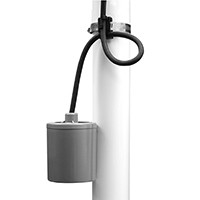
Some sewage pumps have mechanical, also called vertical, float switches. These are attached to a thin rod, which is attached to a floater. As the water level rises, the float rises with it; this in turn raises the rod. This triggers the pump motor, which activates the pump and begins to move the basin contents. As the water level decreases, the floater falls with it, which pulls down the rod and deactivates the motor.
Remote piggyback float switch
A remote piggyback float switch works in the same way as a mechanical float, but is also removable, which allows for manual operation of the pump and easy maintenance of the switch.
Wide angle float switch
A wide angle float switch is composed of a floating ball resting on the surface of the water, attached by a cord. As the water level in the tank increases, the float moves with it, which pulls on the cord. When the cord is taut, it pulls the switch, activating the sewage pump. The switch must be cleaned periodically, as dirt may accumulate in and around the float. Should enough dirt build up, the float will be weighed down in the water, unable to rise with the water level, which will prevent it from activating the sewage pump.
Sizing
In order to accurately size a sewage pump, it is necessary to first determine required system capacity and total dynamic head.
Calculating the system capacity using the “fixture unit” method simply involves counting the number of water fixtures within the structure. Each structure has an individual unit value; to determine the total fixture units, the fixture’s unit value is multiplied by the number of fixtures in the home. The graph below can be used to reference the system capacity:
Total dynamic head is the sum of the static head (vertical lift) and the friction head. The static head is the actual vertical distance that the sewage pump lifts the water. The friction head is the “equivalent length of pipe” plus the actual length of pipe multiplied by the loss due to friction, and then divided by 100.
- To determine the equivalent length of pipe, the lengths of all the pipe fittings required for a given system are added together. For example, in Table A below, for a 1-1/4 inch pipe, three 90-degree elbows and one check valve give a total equivalent length of 22 feet.
- The actual pipe length is what runs horizontally from the house, which should be visible at the pipe’s point of discharge from the house. For this example, let the actual length equal 100 feet.
- Friction loss is a measure of how much the flow of water through the pipe is slowed by the force of friction; this depends on both the size of the pipe and the GPM of water moving through the pipe. Using the previously determined system capacity as the GPM in Table B, if the flow is 18 GPM through the 1-1/4 inch pipe from the previous example, then the loss due to friction is 5.25 per 100 feet of pipe.
- To determine the friction head, the actual length (in this case, 100 feet) and the equivalent length (22 feet) are added together, then multiplied by the friction loss (5.25) and divided by 100. So, (100 + 22)(5.25)/100 = 6.4 feet.
- The total dynamic head, then, is the sum of the static head (13 feet) and the friction head (6.4), which for this example is 19.4, but should be rounded up to 20 feet.
Using the system capacity and the total dynamic head, the final step is to consult a pump curve. A pump curve is unique to every type of pump, and illustrates the GPM a particular pump can produce for a given head. It is important to select the sewage pump that best matches the calculated GPM and head height; otherwise the pump may be either too small or large for the required application.
It is also important to know the diameter of the solids required to pass through this system. Sewage pumps are designed for solids of up to 3/4 inches in diameter; any greater than that and the system may require a sewage pump.
Applications
Sewage pumps are used to transport liquids and solids from a septic tank to drain lines, or to a main sewer. These pumps can be used for residential, commercial, and industrial use. They may be installed in waste water stations, septic systems, campgrounds, construction drainage, and others.
Sewage pumps are better equipped at handling large debris and other solids than sump or effluent pumps. These pumps can easily pass solids of up to 2 inches in diameter, in addition to waste water. All sewage pumps are submersible and designed for continuous duty.
Related documents: